How AI Search Is Changing Health Content Marketing, and How to Stay Visible
I first dipped my toe into health content marketing as a guest blogger for a large commodity board I interned with in 2018, and between then and now, health content marketing followed a fairly similar playbook: find what people were searching for, create a useful article around that topic, optimize it for SEO using low-difficulty, high-volume keywords, and work towards ranking high enough to earn the click.
But for the past few years, that model has been shifting.
A growing number of consumers are no longer typing a question into Google and opening several different websites to compare answers. Instead, they're asking ChatGPT, Claude, Gemini, or other AI-powered search tools to summarize the information for them. Even within traditional search engines, AI-generated answers are increasingly appearing at the top of the results page.
In 2026, 60% of U.S. adults surveyed by Pew Research Center said they read the AI-generated summaries at the top of search results. Younger generations were even more likely to read them.
For gut health and wellness brands, that shift has changed how content is discovered, evaluated, and surfaced. But it's not all doom and gloom, and it does not mean content marketing has become irrelevant. If anything, I think it raises the bar.
AI search still depends on information from somewhere. The brands most likely to stay visible are those that publish original, useful, well-structured content that demonstrates genuine expertise and gives both consumers and search systems a reason to trust it. So before you worry that AI search is replacing health content marketing, remember: health content marketing is alive and well. But AI search is changing what effective health content looks like.
Let's dive in.
What Is AI Search?
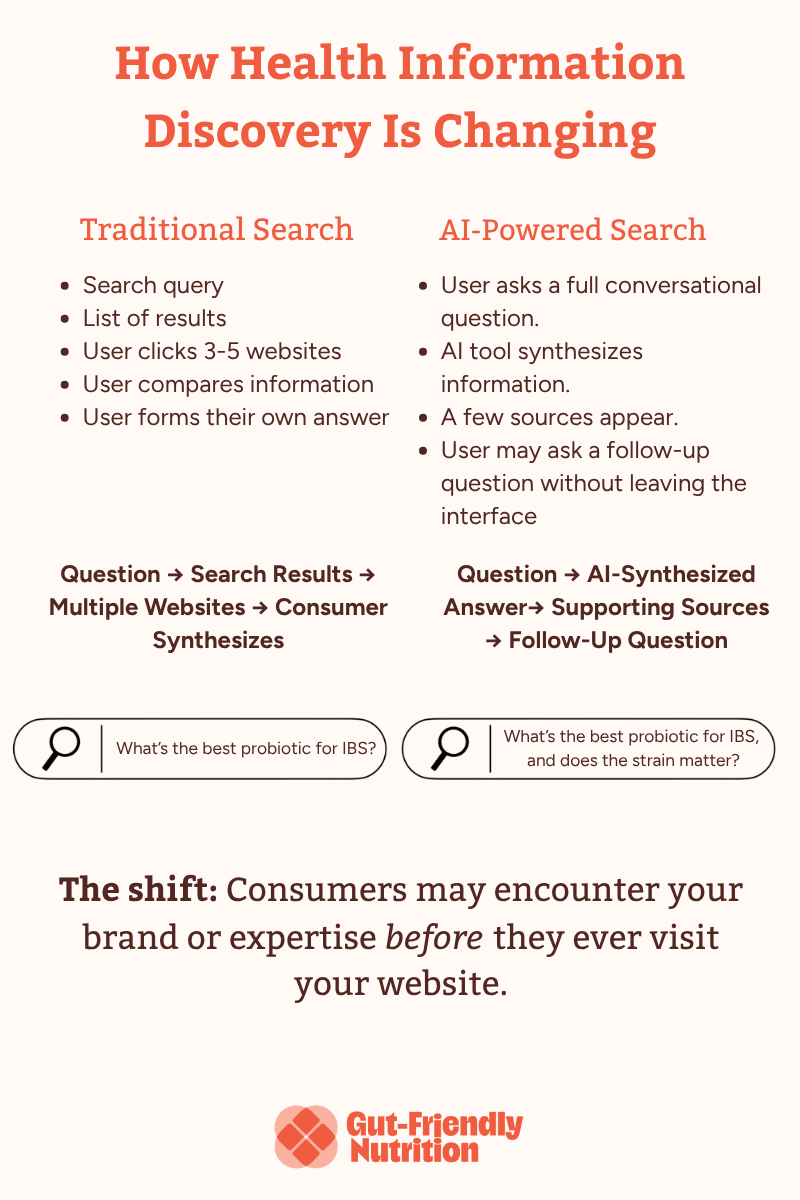
When we used to think about searching for health topics, we thought in terms of SERPs (Search Engine Results Pages). The search engine would give users a list of links, and they'd decide which ones to click. The top one to three results typically see the most traffic, but even being on the first page for your target keyword is considered a good result.
AI-powered search adds another layer. Instead of simply returning webpages, generative search tools can synthesize information across multiple sources, providing a direct, conversational answer to a question. Depending on the platform, this may look like:
An AI Overview at the top of Google results
An answer generated by ChatGPT or Claude
A Perplexity response with citations
An AI search experience that allows users to ask follow-up questions without starting a new search
Let's look at Google's AI Overviews as an example. These short summaries at the top of the search results page are designed to help searchers quickly understand the main points of complex topics. AI Mode goes further by allowing people to ask follow-up questions, compare options, and continue the conversation through multiple related searches across subtopics and data sources.
So, what does that mean for people researching digestive health? Well, they may no longer search for "probiotic benefits" and browse five separate articles individually.
Instead, they may ask, "What's the best probiotic for IBS, and how do I know which product to choose?" An AI tool can synthesize, answer, and present supporting sources all in one place. This is a very different consumer journey.
Why This Matters for Health and Wellness Brands
Health information operates in a high-trust environment, and consumers are already asking AI tools questions like:
What causes bloating?
Which probiotic should I take?
How much fiber do I need?
Should I avoid gluten?
Is this supplement worth taking?
The sources that AI systems use to inform those answers can influence which brands, experts, and organizations consumers encounter. At the same time, AI-generated answers may reduce the likelihood that a person will click through to a traditional website.
In a 2025 Pew Research Center analysis of Google browsing behavior, users clicked a traditional search result in 8% of visits when an AI summary was present, compared with 15% of visits when no AI summary was present. Links cited directly within AI summaries received clicks in just 1% of the visits studied.
This doesn't mean that website traffic is disappearing, but it does mean that brands increasingly need to think more broadly about how they interpret success with their content. Being useful may increasingly mean appearing as a credible source within an AI-generated answer rather than simply occupying position one on a traditional SERP.
The New Rules of Content Visibility
First things first: traditional SEO is not dead. In fact, Google has explicitly stated that existing SEO best practices continue to apply to its generative AI search features. Pages still need to be indexed, technically accessible, and eligible to appear in search.
However, the type of content that stands out is becoming increasingly important. Google's own guidance for AI-powered search emphasized creating unique, valuable, people-first content rather than generic material simply repeating what is already available elsewhere.
For health brands, that means content should be:
Accurate
Genuinely useful
Clearly structured
Supported by appropriate evidence
Written or reviewed by credible experts
Specific enough to answer real consumer questions
Original enough to add something to the existing conversation
An article simply restating the first five search results for "benefits of probiotics" may be technically optimized for a keyword, but it offers very little new value. In contrast, a dietitian-written article that explains why probiotic strain matters, how to interpret a product label, and what the research actually shows is much harder to replace with generic content (and in fact, I wrote an article on that exact topic for the Canadian Digestive Health Foundation, which you can read here).
Why E-E-A-T Is Becoming Even More Important
Google has long encouraged publishers to consider E-E-A-T: Experience, Expertise, Authoritativeness, and Trustworthiness. While Google does not treat E-E-A-T as a single ranking factor, its systems use a variety of signals to identify helpful, credible content. Google also explicitly states that trust is the most important part of the framework.
For health content (classified as Your Money or Your Life, or YMYL), this is even more important. The content practices I'll review below should be top of mind when creating content or developing any kind of nutrition communications.
Make expert authorship visible
A byline from a registered dietitian, gastroenterologist, pharmacist, researcher, or other appropriate professional provides useful context that an anonymous company blog does not. Their bio should make their credentials and expertise easy to understand. When appropriate, you can also link back to their website, LinkedIn, Instagram, or other social media pages so readers can further verify that the content was written by a real person with expertise.
Cite the evidence
Vague statements like "studies show" do little to build credibility. Whenever possible, cite claims, statistics, studies, and professional guidelines. The rules about the "best" way to cite sources are also shifting, and where my clients used to have me link out to sources throughout the content, I now typically provide a numbered list of citations at the end of the article.
The idea behind providing a list at the end is that not linking to external sources keeps people on your website for longer. That said, I feel that it provides a more "clunky" user experience than simply linking to the original source. But at the end of the day, the most important thing is that you're citing your sources somehow.
Be transparent about what was studied (and what wasn't)
This is particularly important in the supplement industry.
Was the finished product studied, or were the ingredients studied separately?
Was the research conducted in humans, animals, or in vitro?
Was the outcome clinically meaningful, or was it biomarker-based?
These distinctions often get erased or overlooked in marketing copy, but they are exactly the type of context credible health communication should preserve.

Create Content That Answers Questions, Not Just Targets Keywords
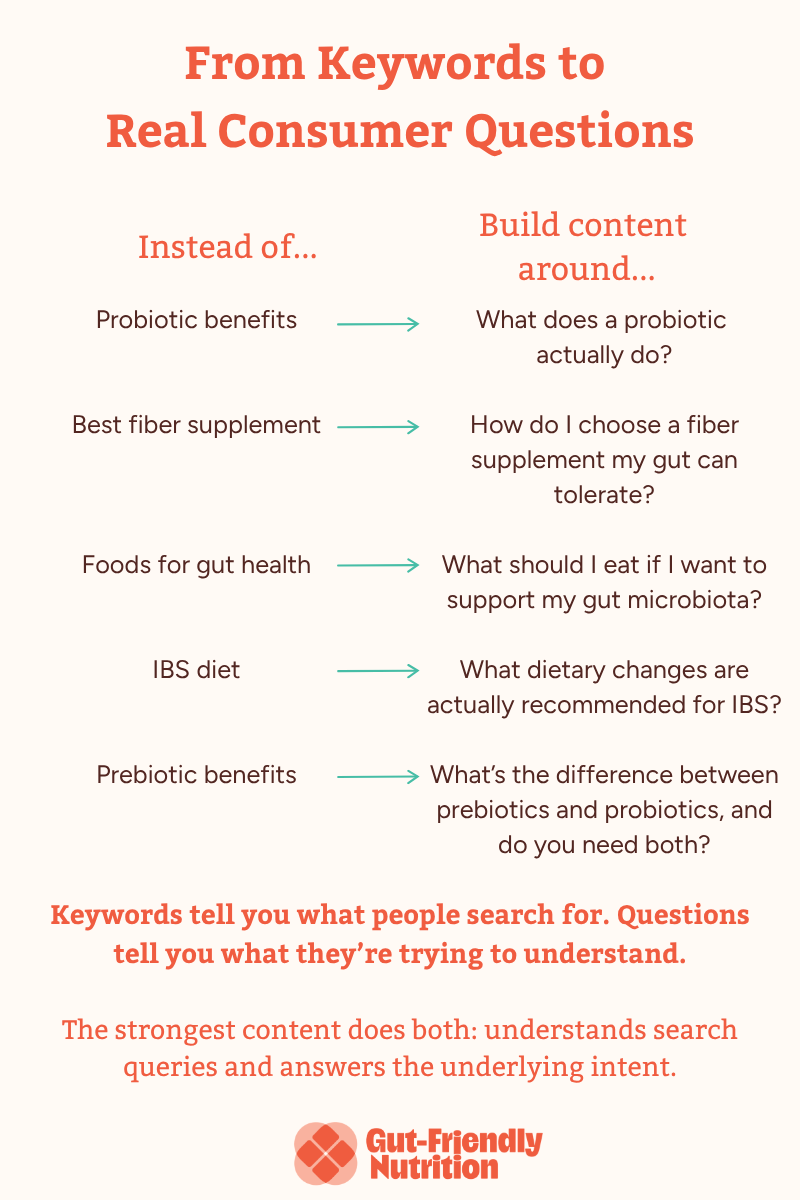
Keywords do still matter because they can help us understand what people are searching for. But keywords are not the same thing as questions. Historically, a brand may have looked at search volume and decided to publish a blog post titled "Probiotic Benefits: 7 Reasons to Take a Probiotic."
Now, the better blog topics may be:
What Does a Probiotic Actually Do?
How Do I Know Whether a Probiotic is Right For Me?
Does Probiotic Strain Really Matter?
These questions become article titles that reflect how consumers naturally ask them—and increasingly, how they interact with conversational AI. Google has reported that people using AI-powered Search are asking longer, more complex questions that, in some cases, may have required several individual searches.
This creates enormous opportunities for health brands to build content around intent rather than just search volume.
Before I write any article, I always ask myself:
What is the person actually trying to understand?
What follow-up questions are they likely to have?
What misconceptions may prevent them from understanding the answer?
What would they need to know before making a decision?
Where does the evidence become less certain?
What practical takeaway can I offer the reader?
Answering those questions helps me create better content for humans, but it may also make it easier for AI-powered systems to identify the content as being relevant to a complex search query.
Structure Content for Humans and AI
As a neurodivergent individual, good structure when creating content is non-negotiable for me because I know how important it is for increasing a reader's ability to skim, identify ideas, and understand the overall concept.
This also matters in an environment where search tools may retrieve information from specific sections of a page rather than treating an entire article as one indivisible piece of content.
Health brands can improve clarity by using:
Descriptive headings: A heading like "How Psyllium Helps With Constipation" communicates much more than "Benefits."
Clear definitions: Define technical language the first time it appears, and do not assume that consumers will understand certain terminology just because it's common in your field.
Answering questions directly: If a heading asks a question, answer it within the first one or two sentences before further explaining the nuance. A reader should not have to scroll through six paragraphs of background before learning whether psyllium is a soluble fiber.
Logical flow: Move from Question → explanation → evidence → practical meaning → limitations → action rather than jumping between product claims and loosely related science.
Useful FAQs: FAQs can capture the questions that arise after someone understands the basics. The goal isn't to stuff the page with every possible keyword variation, but to make the resource comprehensive and genuinely useful.
Original Expertise Is Becoming a Competitive Advantage
This may be the most important shift for health brands. AI can produce a summary of widely available information very quickly. So, what becomes more valuable in that environment?
Information that is not generic.
That includes:
Professional interpretation of research findings
Clinical context
Original research
First-party data
Expert commentary
Patient or consumer insights (when given permission)
Meaningful comparisons
Thoughtful analysis
Firsthand experience.
A registered dietitian specializing in gut health, for example, can contribute something entirely different from a generic summary of fiber guidelines. They can explain that telling everyone with IBS to "eat more fiber" is not particularly useful because different fibers behave differently in the digestive tract, symptoms can vary, and increasing intake too quickly can make someone feel worse.
A researcher can explain what a statistically significant study finding actually means in practice (in other words, is the finding actually relevant?).
A brand's scientific team can explain why a particular formulation was designed the way it was.
Those perspectives create material that AI can potentially reference, rather than merely replicate. It also aligns with Google's increasingly explicit emphasis on original content. Its current guidance encourages publishers to create material that provides unique value rather than simply reproducing information that already exists elsewhere.
As generic content becomes easier to manufacture, expertise becomes more—not less—valuable.
What Gut Health Brands Should Do Now
There's no need to panic and rebuild your entire content strategy around the latest acronym. You may hear terms such as GEO, AEO, or AI search optimization used to describe strategies for appearing in generative search, but the fundamentals are relatively simple.
Keep investing in strong SEO foundations
Your pages still need to be crawlable, indexable, technically sound, and easy to navigate. Google's current guidance is clear that traditional SEO remains foundational to visibility in its generative search experiences.
Audit existing content for quality, not just rankings
Look at your highest-priority articles and ask:
Is this accurate today?
Who wrote it, and are their credentials visible?
Are important claims cited?
Does the article answer the actual question?
Does it contain anything original?
Are limitations acknowledged?
Would a healthcare professional feel comfortable sharing it?
Traffic alone is no longer a sufficient measure of content quality.
Build topical authority
One article on probiotics does not demonstrate deep expertise in the field.
Develop connected resources around the real questions your audience has.
For a fiber brand, that might include:
Soluble vs. insoluble fiber
Fermentable fiber
Prebiotics
Fiber and constipation
Fiber and IBS
How quickly to increase fiber
Fiber supplements vs. food
How to choose a fiber supplement
This creates a useful educational ecosystem rather than a collection of disconnected SEO posts.
Bring experts into the content process
Do not simply add an expert's name after the article has been written. Use their expertise to help shape the content by asking them:
What do your patients misunderstand about this topic?
What questions do patients actually ask?
Where does online advice oversimplify the science?
What would you want someone to know before trying this product?
What recent research is changing the conversation?
This is how expert-led content can stand out in an online world where people face information overload and trust comes at a premium.
Prioritize trust over traffic.
AI search may change traditional click-through behavior, so it's increasingly important to look at metrics beyond pageviews. Consider:
Branded searches
Newsletter sign-ups
Product page engagement
Qualified leads
Healthcare professional engagement
Citations and mentions
Repeat visitors
Conversions
Brand recognition
Google has also begun testing dedicated reporting for visibility within generative AI features in Search Console, reflecting the reality that brands increasingly need to understand AI-search exposure alongside traditional traffic.
Do not flood the internet with generic AI content
I'm probably going to get hate for saying this, but using AI in the content process is not inherently a problem. But using it to manufacture large quantities of low-value content is.
Google explicitly warns that generating many pages of content without adding value for users may violate its policies on scaled content abuse.
AI can help organize research, brainstorm questions, or streamline workflows, but it does not—and should not—replace subject-matter expertise, fact-checking, editorial judgment, or original thinking—particularly in health communication.
The Future of Health Content Marketing Is Still About Trust
AI search is changing how people discover information, but the fundamentals of strong health communication have not disappeared. If anything, I think they matter more.
The brands best positioned for AI search won't be the ones publishing the highest volume of content or chasing every new optimization tactic. They'll be the ones consistently producing information that is:
Accurate
Genuinely useful
Original
Evidence-based
Clearly written
Transparent
Created with real expertise
AI search optimization is not about writing for machines. It's about creating content that is valuable enough for both humans and machines to recognize as worth surfacing.
For gut health brands, that means investing in credibility now. Because as search continues to evolve, being easy to find will matter, and being worth trusting will matter even more.
At Gut-Friendly Nutrition, I help gut health and wellness brands turn complex nutrition science into evidence-based content that consumers and healthcare professionals can understand and trust. From SEO and AI-search-friendly educational content to research translation and media representation, I help brands create resources that add genuine value and expertise to the conversation.
If your content strategy needs to evolve alongside search, let's connect.