The Trust Problem in Gut Health Marketing (And How Brands Can Fix It)
I've been a dietitian for almost a decade, and even in that short amount of time, consumer access to nutrition and gut health information has skyrocketed.
You can learn about probiotics on TikTok, hear about the microbiome on a podcast, read supplement claims on a product page, and receive entirely different advice from a healthcare professional—all within the same day (or even hour).
You'd think that having access to more information would make it easier to make informed decisions. Instead, many consumers are left wondering what to believe.
Do they need to “heal” their gut? Should they avoid certain foods? Is bloating a sign that something is wrong with their microbiome? Does everyone need a probiotic? Which claims are backed by evidence, and which are simply effective marketing?
The growing interest in digestive health has created enormous opportunities for gut health brands, but it has also made the communication landscape increasingly crowded, making trust difficult to earn.
Many gut health marketing strategies unintentionally add to the confusion. They simplify complex science too aggressively, present uncertain findings as established facts, or lead with dramatic claims before consumers understand the problem being addressed.
The brands that succeed in the long term won't necessarily be the ones making the loudest claims. They'll be the ones communicating with the greatest clarity, transparency, and respect for the consumer.
The Gut Health Boom Has Created an Information Overload Problem
When I first started my nutrition education, gut health was a relatively niche clinical topic. But in the past decade, it's moved into the mainstream wellness conversation. The digestive health products market size was valued at almost USD $70 billion in 2025, with estimates suggesting it may exceed USD $150 billion by 2035. Gut health has entered the chat, and it's here to stay.
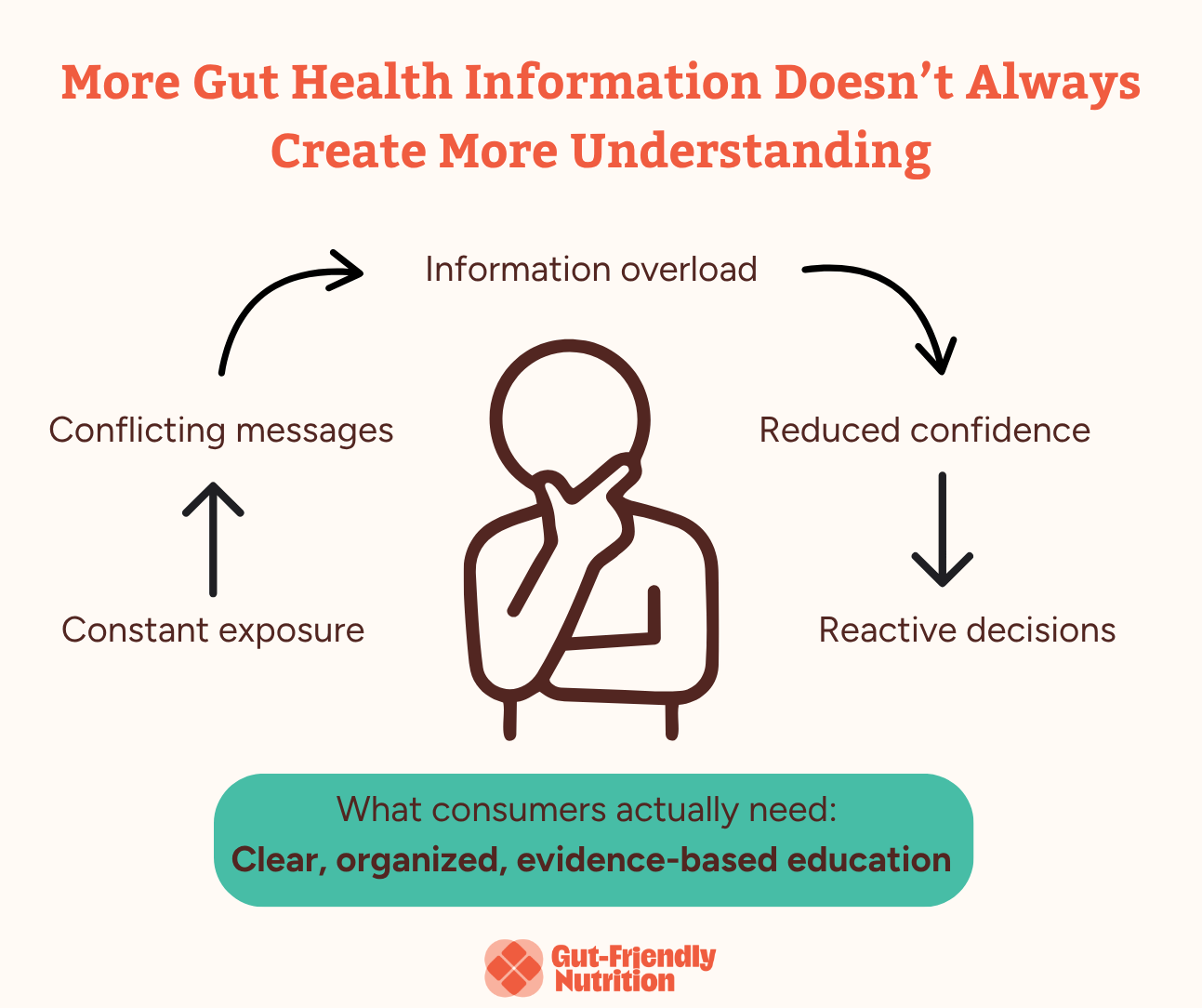
Consumers now encounter information about probiotics, prebiotics, fiber, digestive enzymes, fermented foods, stool testing, inflammation, food sensitivities, and the microbiome across nearly every channel. The problem isn’t just the amount of information, but that much of it isdisconnected, contradictory, or missing the context consumers need to understand it.
Many gut health messages contain a small piece of truth. However, taken together, they can make gut health seem far more confusing than it needs to be. It's a classic example of how more information does not automatically lead to better understanding and, in some cases, can actually reduce confidence in making health-related decisions.
When consumers are presented with too many competing explanations, products, and protocols, they may struggle to decide which advice applies to them. They may cycle through supplements, unnecessarily restrict foods, or conclude that gut health is too complicated to understand and give up entirely.
This is why effective gut health communication and marketing must do more than add another piece of content to the already-crowded conversation. It should help consumers organize the information they’re already receiving and understand how it applies to them.
Why Consumers Are Becoming More Skeptical of Gut Health Claims
Gone are the days when consumers passively accepted every health claim they saw. People are increasingly researching products independently, comparing information across multiple sources, reading reviews, looking for expert input, and asking whether a claim is supported by credible evidence.
As a dietitian, I see this increased scrutiny as a positive development. However, it also means that vague or exaggerated claims are more likely to be questioned by consumers.
Phrases such as:
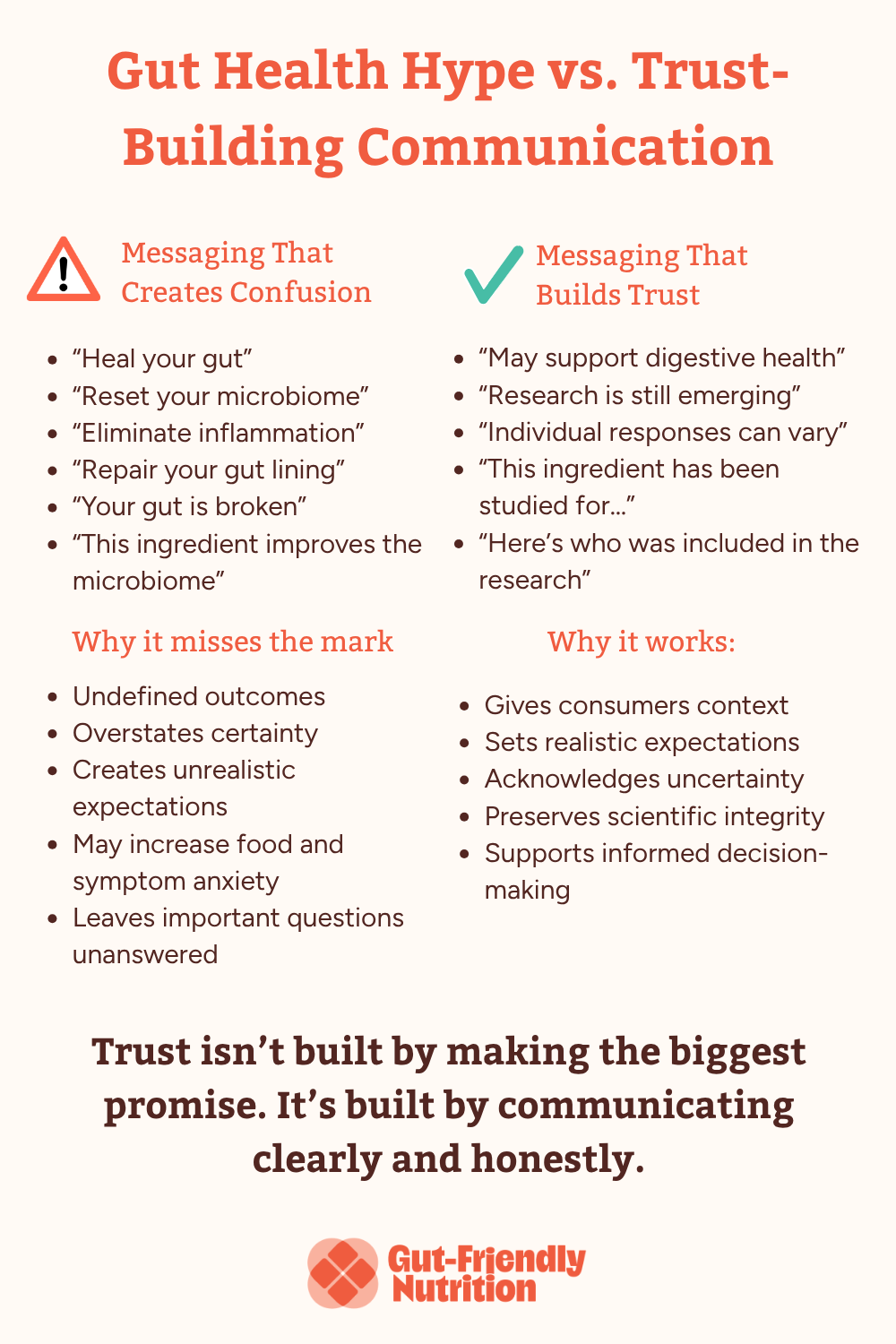
“Heal your gut”
“Reset your microbiome”
“Eliminate inflammation”
“Fix your digestion naturally”
“Repair your gut lining”
may sound compelling, but they often raise more questions than they answer.
What does it mean to heal the gut? How would a consumer know whether their microbiome has been reset? Which form of inflammation is being discussed? What evidence supports the promised outcome? Does the claim apply to everyone or only to a specific population?
When brands cannot clearly answer these questions, consumers may begin to distrust not only the claim, but the brand making it.
Repeated exposure to dramatic promises can also lead to disappointment. A consumer may buy a product expecting instant relief, only to experience a modest benefit, no noticeable change, or new digestive symptoms.
That gap between expectation and outcome is where skepticism grows. Trust is not lost only when a product is ineffective. It can also be lost when the marketing creates expectations that the evidence was never strong enough to support.
The Most Common Mistakes Gut Health Brands Make
I've been working in nutrition communications since 2022, and I see the same messaging mistakes over and over again. While this is by no means an exhaustive list, these are the three mistakes I see most often.
Oversimplifying Complex Science
Gut health is complicated and can be influenced by diet, medication use, age, environment, genetics, health status, geography, and many other factors. Research is evolving quickly, and findings from animal models, laboratory studies, and small human trials do not always translate into clear recommendations for the general public or specific health conditions like IBS.
That inherent complexity doesn't mean brands should communicate in technical language to appear legitimate (using unfamiliar jargon is a fast way to cause your readers to lose interest). It does mean they should avoid turning emerging science into overly certain conclusions.
For example, saying that one ingredient “improves the microbiome” may hide important questions such as:
Which microbes changed?
Were those changes associated with a meaningful health outcome?
Was the research conducted in humans?
Was the end product itself studied, or only one of its ingredients?
How long did the effect last?
Would the same result occur in a different population?
Oversimplification removes so much context that the claim becomes misleading. Good communication simplifies the explanation while preserving its scientific integrity.
Leading With Product Claims Instead of Education
Many brands create content that introduces the solution before helping consumers understand the problem. The messaging may begin with a product benefit such as "Supports a balanced microbiome." But the consumer may not know what microbiome balance means, why it matters, or whether they need support in the first place.
Consumers need context before they can appreciate the solution your product provides, and educational content should help them understand:
What the product is designed to do
Which ingredients are relevant
Who may benefit
What outcomes are realistic
How the product fits alongside food, movement, sleep, medical care, and other health behaviors
When a brand leads with education, the product becomes part of a larger, more credible conversation. When it relies solely on claims, the content can feel transactional.
Creating Fear Instead of Understanding
There's no denying that fear and urgency are powerful attention-grabbers.
But while messaging that suggests a consumer’s gut is “broken,” filled with toxins, or damaged by modern food may generate clicks, it may also make people more anxious about eating and more vulnerable to unnecessary restriction.
Here are some examples I frequently see in gut health messaging:
“Your gut is destroying your health”
“Hidden toxins are damaging your microbiome”
“These foods are feeding bad bacteria”
“Your symptoms prove your gut is unhealthy”
These messages often reduce complex symptoms to a single explanation and imply that the consumer has a problem only the brand can solve. That approach may create urgency, but it rarely creates durable trust.
People living with digestive symptoms are often already frustrated, embarrassed, or overwhelmed. They don't need more reasons to fear food or to believe their bodies are failing. What they do need is clear explanations, realistic options, and guidance about when to seek individualized care.
Why Trust Is Becoming a Competitive Advantage
In a crowded market, product features are easy to copy.
Trust is not.
Consumers may compare ingredients, price points, flavor options, dosages, third-party certifications, and product reviews before making a purchase. But they are also evaluating the way a brand communicates, and may be asking:
Does the brand answer difficult questions?
Does it acknowledge limitations?
Does it explain what the evidence actually shows?
Does it avoid implying that one product will solve a complex health concern?
Does it help the consumer make a decision, even when that decision may be not to purchase?
These behaviors signal credibility to consumers, which in turn builds trust. Trust influences purchasing decisions, repeat business, personal recommendations, and healthcare professionals' willingness to engage with a product. It can also protect a brand when the science changes or when consumers ask more critical questions.
A company that has consistently communicated transparently has room to say, "This is what we know so far." A company built on certainty and dramatic promises has much less room to acknowledge nuance as the science evolves.
Credible education is not separate from marketing. It's a key part of the overall brand experience.
What Trustworthy Gut Health Marketing Looks Like
Trustworthy gut health marketing doesn't need to be dry, overly cautious, or filled with disclaimers, and it can still be engaging, persuasive, and commercially effective. The difference is that it gives consumers enough context to understand what is being promised.
Here are six examples of what trustworthy gut health marketing can look like:
Communicating the evidence clearly: Explaining whether a claim is based on ingredient research, product-specific research, observational data, or randomized clinical trials, and avoiding making every study sound equally definitive.
Acknowledging uncertainty: Getting comfortable saying that research is emerging, individual responses vary, or more evidence is needed. Acknowledging uncertainty doesn't automatically weaken a message. When handled well, it demonstrates honesty and trustworthiness.
Avoiding exaggerated outcomes: Using language such as “may support,” “has been studied for,” or “may help some people” when stronger language is not justified.
Prioritizing consumer education: Explaining the underlying science, defining unfamiliar terms, and helping consumers understand how a product fits into everyday life.
Focusing on practical benefits: Connecting mechanisms to outcomes consumers can understand. Instead of leading with "Supports microbial diversity," explain that "this product contains several types of prebiotic fiber that are fermented by different groups of gut bacteria and can support a healthy gut microbiome."
Citing credible sources: Referencing high-quality evidence and making it possible for interested consumers or healthcare professionals to learn more.
How Brands Can Build Consumer Confidence Through Better Nutrition Communication
Better nutrition communication begins by deciding what the consumer needs to understand—not simply what the brand wants to say.
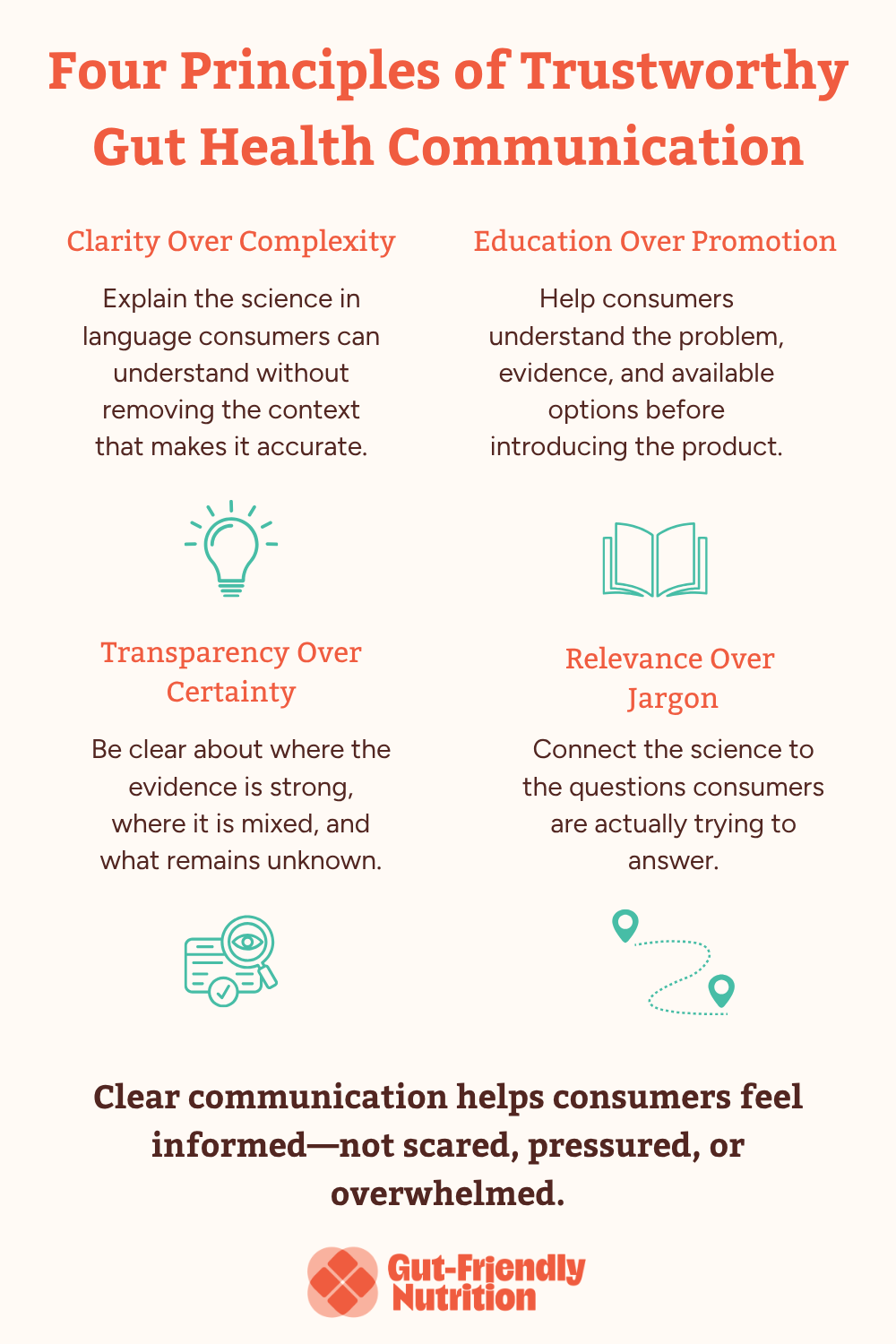
A strong communication process prioritizes four things.
Clarity Over Complexity
Scientific accuracy doesn't have to rely on dry, confusing academic language. Brands can define technical concepts, use familiar examples, and break information into manageable steps without weakening the evidence.
The goal isn't to show how complicated the science is. It's to help the reader understand why it matters to them.
Education Over Promotion
As a dietitian with extensive experience in behavior change counseling, I've seen firsthand how people are more likely to trust a recommendation when they understand the reasoning behind it.
An article about prebiotic fiber, for example, may explain:
What prebiotics are
How they differ from probiotics
Why different fibers may be tolerated differently
Who may benefit from prebiotics
How to increase fiber gradually
When digestive symptoms warrant professional advice
The product can still appear in the content, but it shouldn't replace the education piece.
Transparency Over Certainty
Brands don't need to pretend to know the answer to everything or that their product solves every problem. They can explain where the evidence is strong, where it is mixed, and what remains under investigation.
They can also clarify who was included in the research and whether the findings are likely to apply broadly. This creates more realistic expectations and reduces the risk of consumers feeling misled.
Relevance Over Jargon
The average reader rarely needs every biochemical detail.
They do need to know:
What this means for them
How the product may fit into their routine
What changes they might reasonably notice
How long benefits may take
What side effects or tolerance issues are possible
When to speak with a healthcare professional
Relevance makes science useful. It also helps brands move beyond generic claims and create content that genuinely supports decision-making.
The Future of Gut Health Marketing
Consumers are becoming increasingly more discerning.
They're learning that “natural” does not automatically mean safe and that one person’s gut-health solution may not work for someone else. As this understanding grows, generic promises will become less persuasive.
The future of gut health marketing will belong to brands that can:
Communicate responsibly
Explain complex science without distorting it
Distinguish emerging research from established evidence
Create practical, audience-specific education
Acknowledge individual variation
Build relationships with credible experts
Help consumers make informed decisions
Scientific nuance is an opportunity to show consumers that a brand respects their intelligence and takes their health seriously.
Clarity Is the Real Trust Builder
Consumers are surrounded by more advice, claims, and products than they can reasonably evaluate. Brands that add more hype to that environment may attract attention, but they're unlikely to build lasting confidence.
The strongest brands will simplify without oversimplifying, educate without overwhelming, and promote without exaggerating. They'll help consumers understand what a product can and cannot do and how it fits into the bigger picture of digestive health. In an increasingly crowded marketplace, trust may be the most important differentiator a gut health brand can build.
At Gut-Friendly Nutrition, I help gut health brands translate nutrition science into content that feels genuine, approachable, and actionable. If you're looking for a dietitian partner who can help your brand simplify the science and communicate your value clearly and credibly, I'd love to connect.
Let's create nutrition content people trust.