Evidence to Everyday: How Gut Health Brands Can Communicate Nutrition Science Clearly
Imagine this: A person with ongoing bloating issues is searching for answers about why they're so bloated all the time.
They land on your article explaining that alterations in gut microbial diversity can affect digestive function, potentially due to changes in gut barrier integrity or due to the fermentation of highly fermentable carbohydrates.
The article is technically accurate. It cites high-quality research. It even naturally promotes your product.
But after reading the article, the person is left wondering:
How does this explain my bloating?
Do I need to be doing anything differently?
How does this product fit into my life?
This is a common challenge I see in communicating nutrition science.
Providing scientifically accurate information is essential, but accuracy alone won't cut it. If consumers still can't understand how this information relates to their struggles, even the most evidence-based content can fall flat.
Effective gut health, nutrition, and science communication should act as a bridge between research and real-world decisions consumers make every single day. The science needs to be translated into clear, practical takeaways while still holding space for the nuance and credibility health messaging requires.
As a dietitian with almost a decade of experience split between clinical work and writing relatable health content for top-tier publications and brands, I'm deeply familiar with what works in consumer health education. This article will share my top strategies for creating nutrition education that drives audience engagement and ultimately builds brand recognition and trust.
Why Nutrition Communication Matters More Than Ever
Let's face it: we live in a time where people have never had more access to nutrition information. A quick search can generate thousands of articles, social media posts, videos, podcasts, and AI-generated answers on any health topic you can think of.
So, we know the problem isn't a lack of information.
Instead, it's knowing what to do with the sheer volume of information available to us.
As a dietitian, I've seen firsthand how this plays out. On any given day, a person may encounter headlines telling them to eat more carbohydrates, cut out carbohydrates, eat more fiber, avoid certain fibers, take probiotics, or skip probiotics altogether. Even the most well-educated people can get lost in the sea of information available to them, leaving them overwhelmed and unsure what applies to them.
This state of confusion and overwhelm poses a serious challenge to gut health brands. Your potential clients aren't just evaluating your product—they're trying to understand whether the information about your product is credible.
When complex nutrition science is communicated poorly, here's what I commonly see happening:
Consumers may not understand key concepts
Important nuance may be lost
Expectations may become unrealistic
Trust can erode when claims feel exaggerated or inconsistent
Here's an example: while the statement "the gut microbiome influences health" is scientifically accurate, without enough context, consumers are left wondering what that really means, whether it applies to their specific situation, and what actions they should take.
Effective nutrition communication bridges the gap between science and action.
Instead of overwhelming people with scientific jargon, effective nutrition communication translates the science into clear, practical takeaways that people can directly apply to their lives. It provides the context needed to understand the topic while staying engaging, approachable, and actionable.
This matters because in a wellness landscape filled with companies overpromising on what their product can do, trust has become one of the most valuable assets your brand can build.
As someone who has worked on both sides of the equation—as a clinical dietitian and a nutrition communicator—I can confidently say that what consumers want is for brands to help them understand their options rather than simply being sold science. They want access to information that's credible, transparent, and useful. Brands that consistently provide that experience are much more likely to build long-term relationships and strengthen customer loyalty in a crowded marketplace.
Great nutrition communication doesn't just improve a person's understanding of your product. It builds trust, confidence, and meaningful connection between your brand and the people you serve.
Start With the Consumer, Not the Research
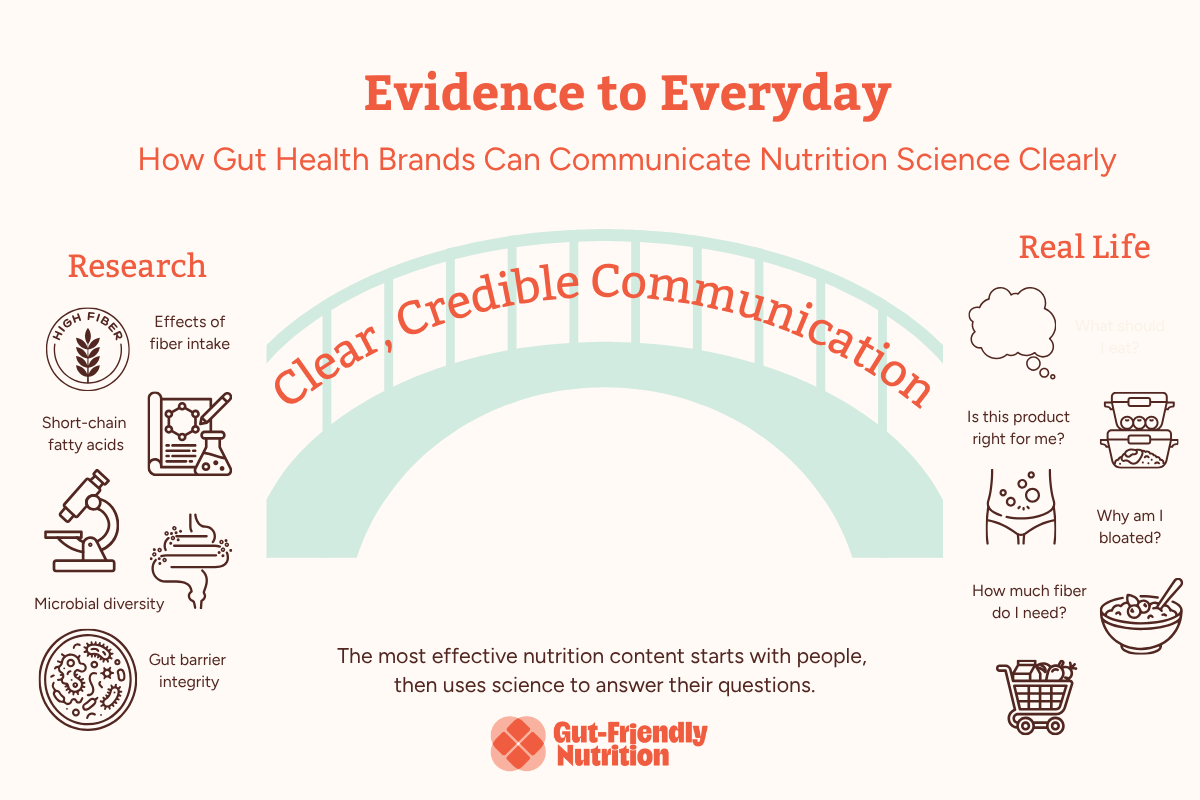
One of the biggest mistakes I see in nutrition communication is starting with the science instead of the person reading it.
Researchers, healthcare professionals, and brands are often fully immersed in the latest studies and emerging evidence, so it's natural to want to lead with exciting findings, especially when they're directly relevant to your product. But consumers rarely approach health information from that perspective.
Here's an example: most people aren't looking for information because they're curious about short-chain fatty acids or microbiome diversity. Instead, they're searching because they have a question, concern, or goal.
Consumers want to know:
Why do I feel bloated all the time?
How can I improve my digestion?
Should I take a probiotic?
What's the best way to get more fiber without getting gassy or bloated?
When your content starts with research, it feels disconnected from what the reader actually needs. Even if the information is scientifically accurate, consumers may struggle to understand why it matters or how it applies to their unique situation.
That's why my approach to nutrition communication starts by asking three simple questions:
What problem is this reader trying to solve? Every piece of content should address a specific need, challenge, or question.
What does this information help them do? Consumers want more than information. They want guidance, context, and practical next steps that actually apply to them.
What questions are they already asking? The most engaging health content meets people where they're at and answers the burning questions they're already thinking about.
When you start creating your messaging with consumer concerns at the forefront, your content instantly becomes more relevant, relatable, and actionable.
Let's take a look at how this would look in practice. Imagine you're creating content about the microbiome.
A science-first approach might say: "The gut microbiome influences metabolic health."
While technically accurate, this terminology may be unfamiliar to many consumers, and they may not understand why they should care.
A consumer-first approach might say: "Your gut bacteria may play a role in everything from digestion to blood sugar control."
While the underlying scientific rationale remains intact, the second statement immediately connects the information to outcomes that feel relevant to consumers' everyday lives. This doesn't mean abandoning scientific accuracy. Instead, it's about creating a bridge between research and lived experience.
The most effective nutrition content starts with people, then uses science to answer questions they're already asking—not the other way around.
Translate Scientific Language Into Everyday Language
Before diving into this section, I want to make one thing very clear: Scientific accuracy and clear, effective communication are not mutually exclusive.
In fact, I'm a strong believer that some of the most effective nutrition communicators can explain complex concepts in a way that feels simple, approachable, and easy to understand, without sacrificing accuracy.
Unfortunately, I see many brands in the gut health space unintentionally creating barriers to understanding by relying too heavily on technical language or industry jargon.
Terms like dysbiosis, gut permeability, microbial diversity, and fermentable carbohydrates may be familiar to people who work in this field, but they can feel confusing and intimidating to consumers. When a consumer encounters too many unfamiliar terms, they may stop engaging with the content altogether.
That said, this doesn't mean you can't use the terms. However, translating scientific language into everyday language is critical to keeping consumers engaged.
Focus on Clarity Over Complexity
Many brands assume that using scientific language makes their content more credible. In reality, using these terms without explaining them can confuse consumers who may not be familiar with the terminology.
Remember, credibility comes from helping people understand the information. Someone who fully understands a concept is far more likely to trust it than someone overwhelmed by technical jargon. Whenever possible, choose plain language.
Here are some examples:
Instead of: "Dysbiosis"
Try: "An imbalance in gut bacteria"
Instead of: "Fermentable carbohydrates"
Try: "Certain carbohydrates can trigger digestive symptoms in some people"
Instead of: "Microbial diversity"
Try: "The variety of different microbes living in your gut"
Instead of: "Gastrointestinal symptoms"
Try: "Digestive symptoms like gas, bloating, or changes in bowel habits."
Define Technical Terms When They Matter
While it's generally best to use simple language as much as possible, that doesn't mean you should avoid scientific terminology altogether. There are absolutely situations where using technical terms is important, especially if you're discussing emerging research or product benefits.
In those situations, explain the technical term as simply as possible.
For example:
"Prebiotics are types of fiber that feed the beneficial bacteria living in your gut."
Or:
"The gut microbiome is the community of trillions of microorganisms living in your gut."
A brief definition of the term can help readers understand the topic while preserving scientific accuracy.
Write Like You're Explaining It to a Curious Friend
One of the easiest ways to make your writing feel more approachable is to imagine you're explaining the concept to an intelligent, curious friend who has no formal education in nutrition or gut health.
Would they understand the language you're using?
Would they know why the information should matter to them?
Would they be able to explain it to someone else afterward?
If the answer to any of these questions is no, you may need to review the content and identify ways to simplify it further without losing meaning.
Remember: Trust Is Built On Understanding, Not Overwhelming People With Information
Consumers don't trust your content because it sounds scientific. They trust it because it helps them make sense of complex topics that are directly relevant to their lives.
When brands communicate in clear, accessible language, they remove barriers to understanding, creating a better experience for their audience and helping them walk away feeling informed, confident, and empowered to make decisions about their health.
Focus on Outcomes, Not Mechanisms
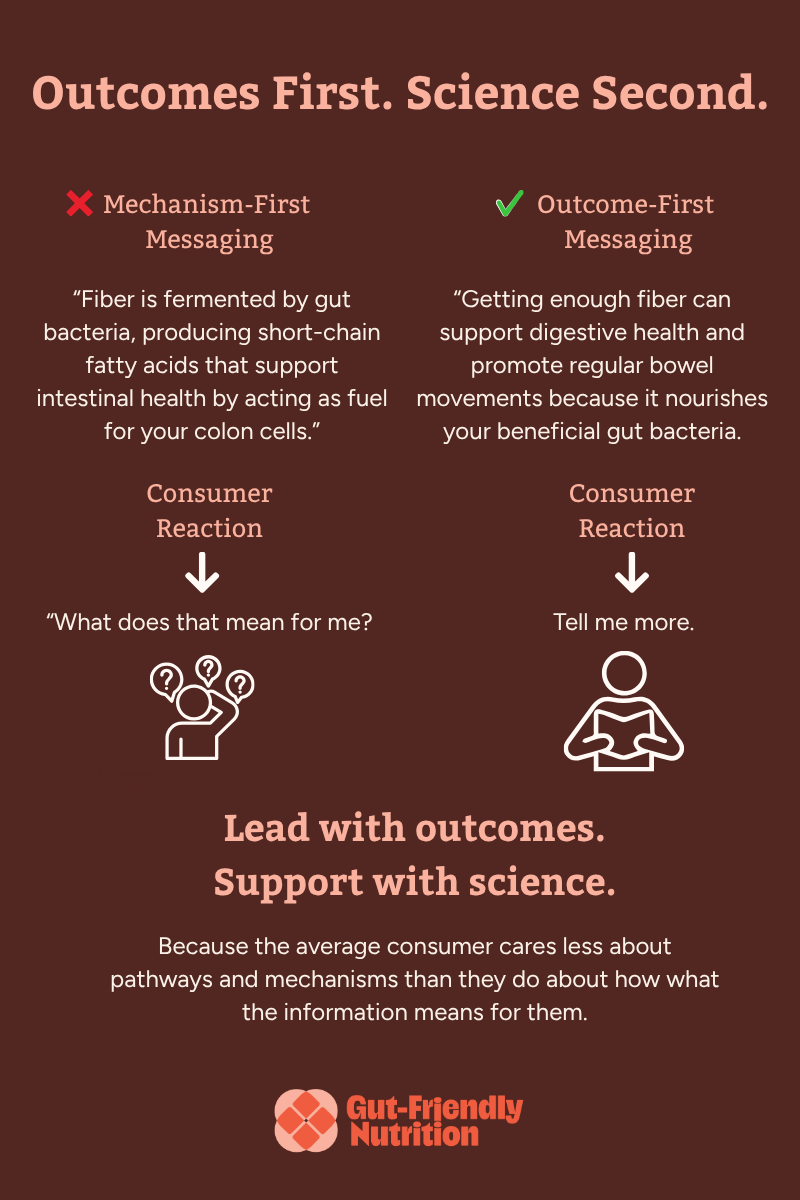
One of the easiest ways to lose readers is to spend too much time explaining how something works before explaining why it matters.
I get it: as researchers and healthcare professionals in the gut health space, we're often fascinated with the "how" of why a product works and why the intervention may be effective.
But consumers aren't focused on the "how." They want to know:
Will this help me feel better?
How will this affect my symptoms?
Is this relevant to my situation?
What should I do with this information?
Effective nutrition communication leads with outcomes rather than mechanisms.
Start With What Matters to the Reader
Let's start with a classic example in the gut health space: getting people to eat more fiber.
A mechanism-first approach might say something like this:
"Fiber is fermented by gut bacteria, producing short-chain fatty acids that support intestinal health."
While scientifically accurate, the reality is that most consumers probably don't know what short-chain fatty acids are or why they should care about them.
An outcome-first approach looks a little different:
"Getting enough fiber can support digestive health, promote regular bowel movements, and help nourish the beneficial microbes in your gut."
See the difference? Now the reader immediately knows what the benefit is.
Once you've established relevance, you can introduce the science that supports the benefit:
"One reason fiber supports gut health is that the beneficial bacteria in your gut ferment (“eat”) certain types of fibers, producing compounds called short-chain fatty acids, which nourish the cells in your colon and reduce inflammation."
The science doesn't disappear. It's simply contextualized in a way that's easier for consumers to understand and connect to.
Connect the Science to Real-Life Benefits
Whenever possible, start your content with:
Practical benefits
Everyday applications
Consumer questions
Real-world outcomes
Then use science to support and explain these benefits.
For example, instead of:
"Probiotics may influence gastrointestinal function by interacting with the gut microbiota and immune system."
Try,
"Certain probiotic strains may help reduce uncomfortable digestive symptoms like bloating and diarrhea. This may be because they interact with both the microbes living in your gut and the immune system."
See how the second example is more engaging because it directly answers the reader's most important question first: "What does this mean for me?"
Mechanisms Should Build Understanding, not Lead the Conversation
Explaining why something works can add credibility and important context, helping readers understand why a recommendation exists. But they work best as supporting information, not the main message.
Consumers don't need an in-depth lesson in gut physiology to appreciate the value of fiber, probiotics, or dietary changes. They need a clear understanding of why that information matters to them and how it relates to their lives.
By leading with outcomes and following with science, you can create content that is both evidence-based and engaging. The goal isn't to completely remove the science—it's to make it more meaningful. That starts with understanding that consumers are looking for solutions, not mechanisms.
Use Stories, Analogies, and Examples
One of my favorite ways to teach complex nutrition and gut health concepts is to use analogies. These help consumers quickly grasp new ideas without needing to be experts in nutrition or gut health.
Here are some examples:
The gut microbiome can be compared to a garden, where different microbes thrive under different conditions and with different food.
Prebiotic fiber can be thought of as fuel for beneficial gut microbes.
Digestion can be framed as a team effort involving multiple organs, enzymes, and microbes, all working together.
Stories and examples can be equally effective. Starting with a relatable problem or question your audience may have makes the science instantly more accessible. When consumers can visualize a concept and understand how it relates to their own experiences, they're more likely to engage with (and remember) information.
Balance Accuracy With Accessibility
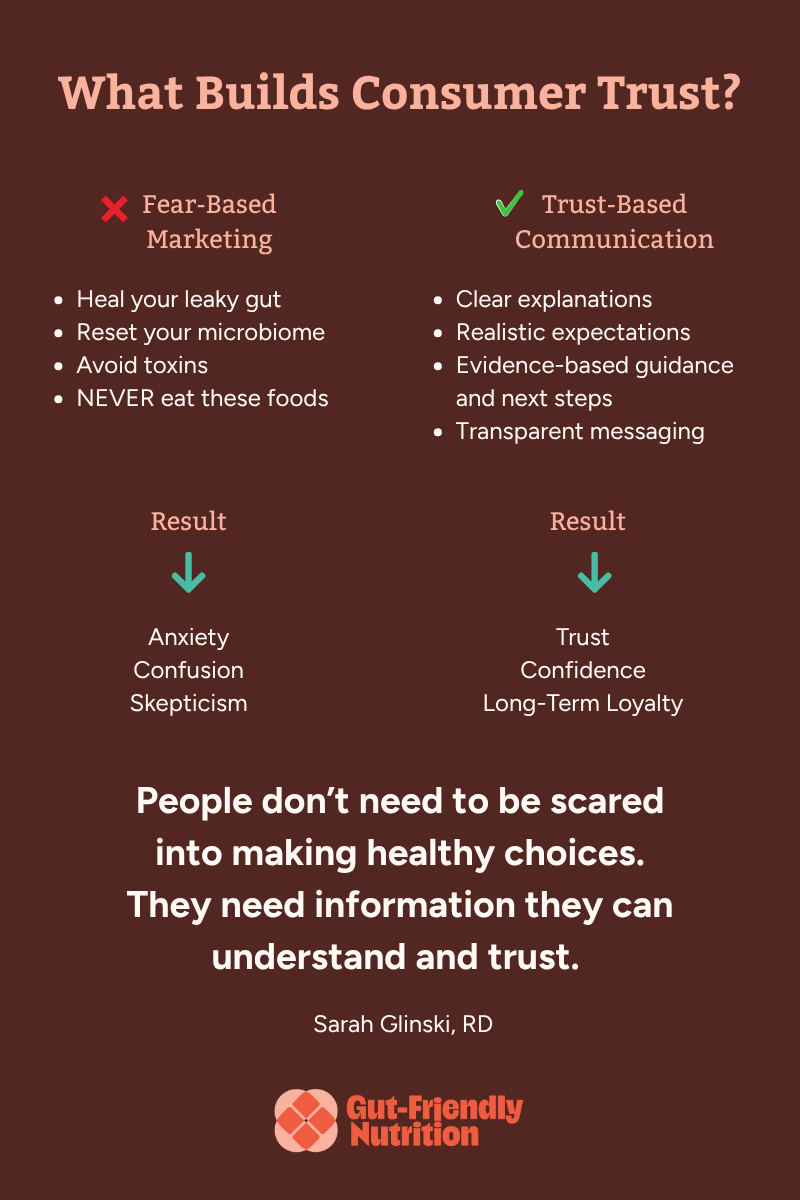
One of the biggest challenges in ethical nutrition communication is striking a balance between scientific accuracy and consumer understanding.
Some brands lean so heavily on the science that their content feels dry, inaccessible, and frankly, not memorable. Others simplify complex topics to the point where important context is lost. In both cases, trust can be quickly lost because consumers aren't getting the information in a way that makes sense to them.
Effective nutrition communication makes information easier to understand without sacrificing scientific accuracy or losing nuance.
Avoid Oversimplifying Complex Topics
Anyone in the nutrition and gut health space knows that science is rarely black-and-white.
Topics like the gut microbiome, probiotics, food sensitivities, and personalized nutrition are constantly evolving, as we need to communicate this responsibly. While consumers are looking for clear answers, reducing these nuanced topics to overly simplistic statements risks causing confusion and unrealistic expectations.
For example, claims such as "heal your gut" or "reset your gut microbiome" may sound compelling, but they vastly oversimplify complex health conditions and imply outcomes that evidence may not actually support.
Instead, I recommend communicating what we know, what we're still learning, and what consumers can realistically expect from using your product.
Resist the Temptation to Use Fear
Fear-based messaging is rampant in the wellness industry because it instantly grabs attention.
Messages that suggest people are unknowingly damaging their gut, eating the "wrong" foods, or exposing themselves to toxins may generate clicks, but they can also increase health anxiety and quickly erode trust.
In my work, I take a different approach.
I don't believe people need to be scared into making healthy choices. Instead, I focus on helping people understand the options available to them, how to critically evaluate health information, and how to make informed decisions based on evidence, not fear.
Trust in a brand or product is built when consumers feel supported and educated, not alarmed or judged.
Communicate With Confidence, Not Certainty
Consumers aren't expecting you to have all the answers. But they do expect you to be honest.
The most effective nutrition communicators provide clear guidance while acknowledging complexity. They simplify information without oversimplifying it, communicate benefits without exaggerating them, and educate without creating fear.
In a wellness marketplace crowded with bold claims and conflicting advice, responsible communication stands out. Ultimately, brands that prioritize accuracy, transparency, and trust are more likely to build lasting relationships with the people they serve.
Build Content Around Action
Even the most engaging nutrition content falls short if the reader reaches the end and says, "Now what?"
Every piece of content should answer one simple question:
"What should someone do with this information?"
People are busy. They're looking for practical, simple guidance, not just education. While explaining the science is important, it's equally important to teach readers how to apply it in their own lives.
For example, if you're explaining the benefits of fiber, include examples of high-fiber foods, simple meal ideas, or realistic ways to increase fiber intake.
When consumers can quickly connect information to concrete action, content becomes more useful, more memorable, and more likely to drive meaningful behavior change.
Great Nutrition Content Builds Trust
At its core, great nutrition communication builds trust.
That trust is earned through transparency, consistency, scientific accuracy, and practical value. Brands prioritizing education over promotion are more likely to build long-term credibility than those relying on exaggerated claims or fear-based marketing tactics.
The most effective gut health brands don't just share new research findings—they help consumers understand what those findings mean and how to apply them to their own lives.
In an increasingly crowded marketplace, the brands that stand out won't necessarily be the ones making the biggest promises. They'll be the ones creating content that makes consumers feel informed, confident, and supported.
At Gut-Friendly Nutrition, I help gut-health brands translate complex nutrition science into content that consumers actually understand and trust. From SEO and GEO blog posts to healthcare provider resources and media representation, I create evidence-based communications that educate, engage, and build credibility.
If you're looking for a dietitian partner who can help your brand simplify the science and communicate your value in a meaningful way, I'd love to connect.
Let's create nutrition content people trust.